In-Building Cellular and Distributed Antenna Systems
Buildings are built to keep the weather out, and the same materials keep radio signal out with it. Low-emissivity glass, concrete, structural steel, foil-backed insulation and below-grade construction all attenuate cellular signal — and the more energy-efficient a building is, the worse it usually performs.
The result is familiar: full bars in the parking lot, nothing at the elevator bank. Calls that drop in stairwells. Staff who step outside to use their phones. Tenants who raise it in every renewal conversation.
A distributed antenna system solves it properly — capturing carrier signal, amplifying it, and distributing it through the building so coverage is even everywhere it needs to be.
What a Properly Designed System Changes
Below are signal readings taken in a building before and after an in-building system was installed, measured across three carriers. The upper row is the building as found; the lower row is the same building afterwards.
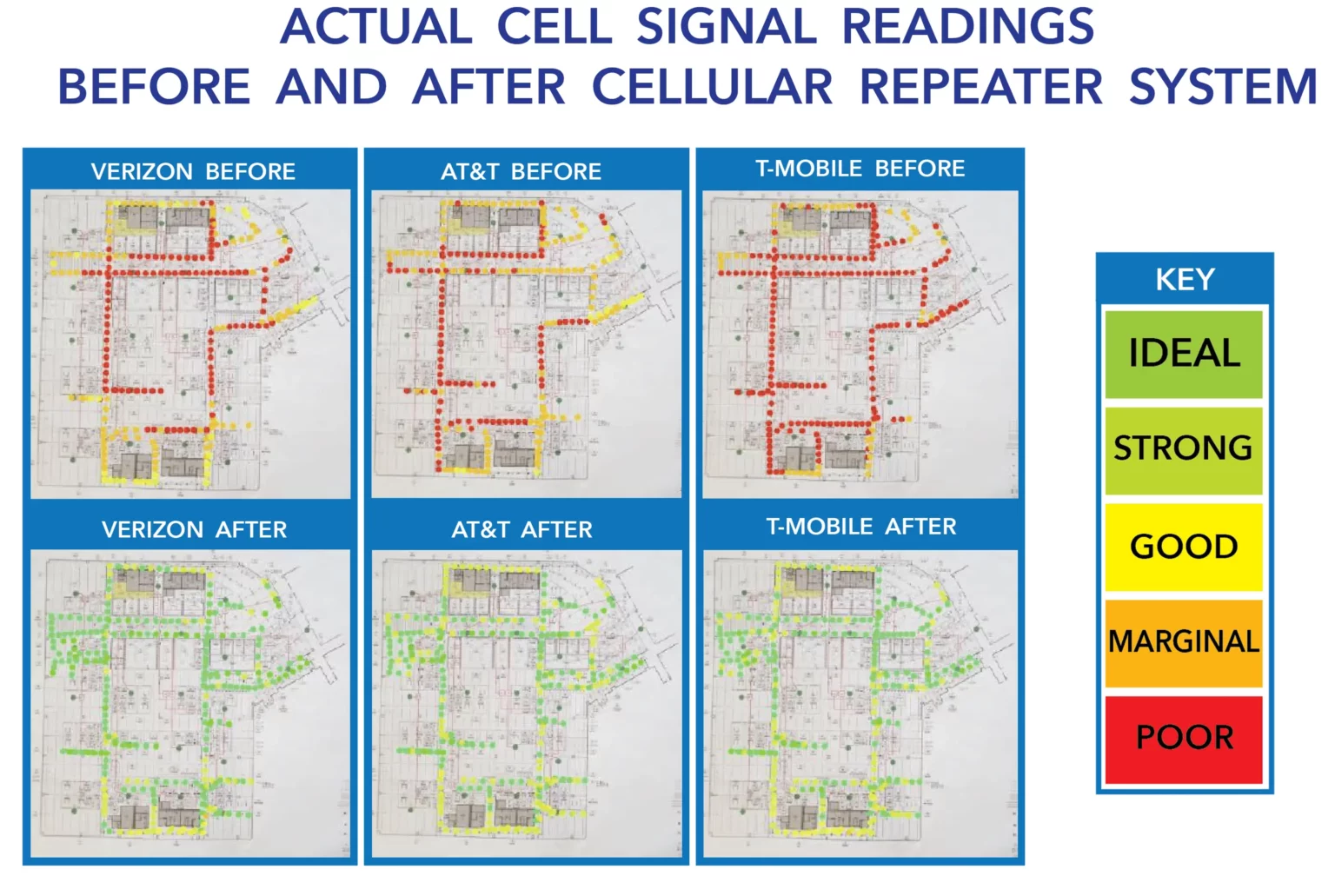
This is why the survey comes first. Coverage is not uniform, it differs by carrier, and the only way to design a system that works is to measure the building rather than estimate from floor plans.
Choosing the Right System Type
Not every building needs the same solution, and the cost difference between them is substantial. The right answer depends on building size, how poor the existing signal is, and how many carriers have to be supported.
Off-air repeater
Pulls signal from a nearby carrier site and rebroadcasts it inside. Lowest cost, suited to smaller buildings where some usable outdoor signal already exists.
Passive DAS
A signal source feeding a network of coaxial cable and antennas. Good coverage for mid-sized buildings without active electronics on every floor.
Active DAS
Fiber to remote units throughout the building, each with its own amplification. Scales to large and high-rise buildings and supports multiple carriers cleanly.
Small cells
Carrier-provided nodes that add capacity as well as coverage. Useful where the problem is congestion rather than weak signal.
In practice most buildings above a certain size end up with a hybrid — active distribution on the risers, passive on the floors. For apartment communities specifically, see multifamily coverage.
Carrier Approval Is Part of the Job
Any system that rebroadcasts a carrier’s licensed spectrum needs that carrier’s consent. This is the step that surprises people, and the one most likely to hold up a schedule if it is left until the end.
- Consumer boosters — pre-approved under FCC rules, but limited in output and unsuitable for most commercial buildings.
- Industrial signal boosters — require carrier registration and, in most cases, written approval before activation.
- Active DAS and small cells — carrier engineering involvement, with each operator reviewing and approving the design.
Approval timelines vary by carrier and market. We start that conversation during design rather than after installation, because a finished system that cannot legally be switched on helps nobody.
What Installation Involves
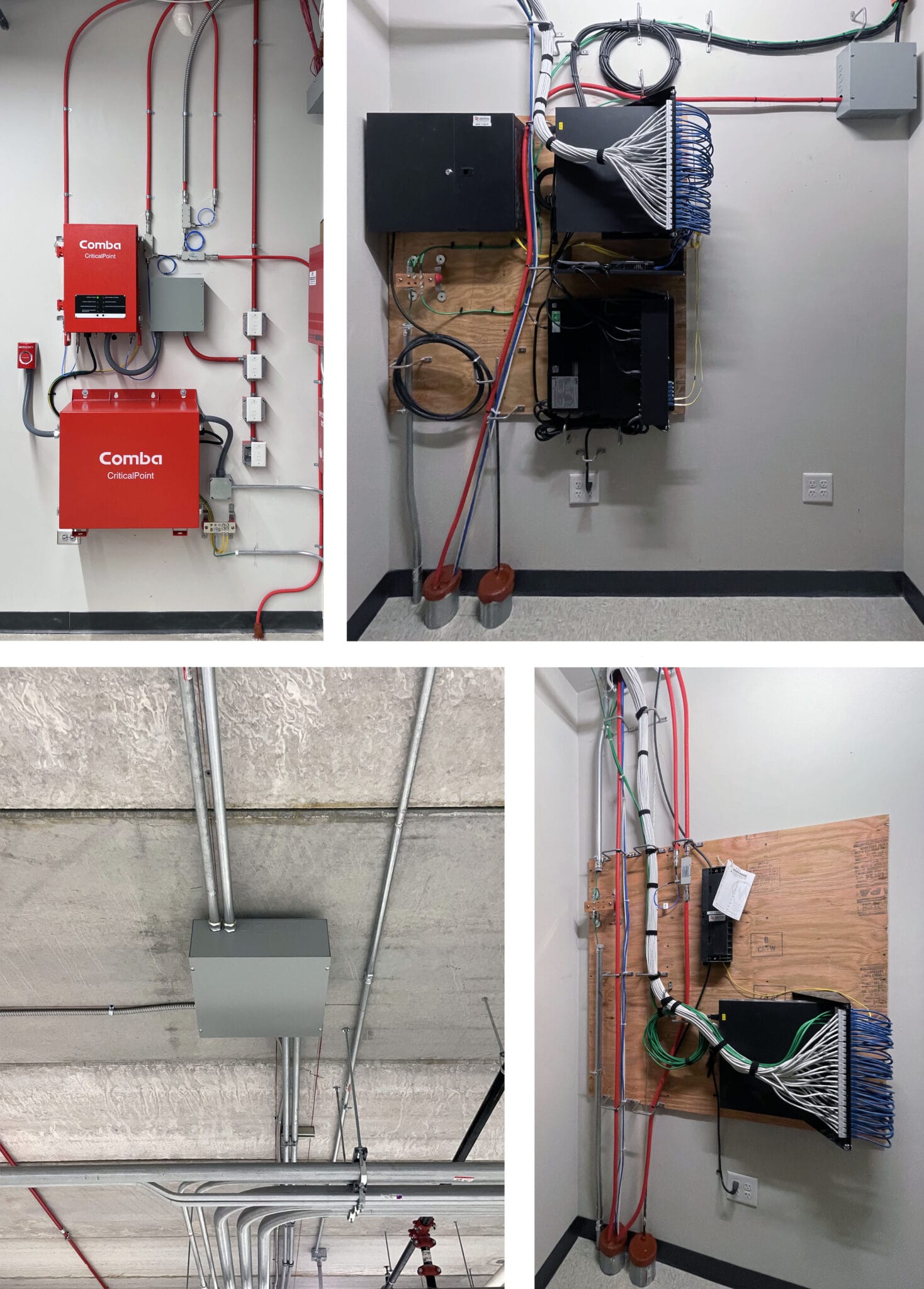
An in-building system touches more of a building than most people expect. It needs riser space, pathways, power and a home for the head-end equipment, and all of it has to be coordinated with the other trades.
- Rooftop work — donor antennas, mounts, penetrations and weatherproofing.
- Riser and pathway — vertical distribution, sleeves and firestopping at every floor.
- Head-end space — an equipment room or closet with power, cooling and access.
- Ceiling antennas — placed from survey data, not spaced on a grid.
- Commissioning — walk-testing the finished system and correcting the gaps before handover.
Coordinating this during construction costs a fraction of retrofitting it afterwards. The worst time to discover a building needs a riser is after the walls are closed.
Cellular and Public Safety Together
Cellular coverage and emergency responder radio coverage are different systems on different frequencies, and they are governed differently — one is a tenant expectation, the other is a code requirement enforced by the fire marshal.
They are not the same project, and a cellular DAS does not make a building compliant with the fire code. But they share rooftop space, riser paths, equipment rooms and, often, the same survey visit. Designing them together avoids paying twice for the same infrastructure and avoids the second system arriving to find the pathways already full.
If your building needs both, it is worth scoping both at the same time even if they are installed in phases. Our Public Safety ERRCS page covers the code requirements in detail.
Start With a Survey
Whether a building needs a repeater or a full active system is a question that measurement answers and guesswork does not. A benchmark survey establishes what coverage exists today, carrier by carrier, and what it would take to fix it.