A Q&A with Ted McCausland, Partner & General Manager, LINX Multimedia
When companies invest millions in multimedia technology, it’s not about sporting snazzy new technology. Sure, there is an element of that, especially the “wow” factor for customers, partners, and employees. But more importantly, these organizations are investing in differentiation and competitive advantage, and ultimately expect an ROI. Ted McCausland has spent years helping organizations across industries build AV infrastructure that delivers real results to their operations. As Partner and General Manager of LINX’s $33 million multimedia division, he’s seen firsthand how purpose-driven technology deployment creates measurable business impact. From Fortune 500 boardrooms to NFL stadiums, McCausland and his team design and install systems that impress technologically and deliver results.
Q: What drives companies to invest in multimedia AV technology today?
It really comes down to helping companies be more efficient and effective in their business dealings so they can stay competitive. Collaboration amongst in-house and offshore team members is also important for people to remain competitive in their respective marketplaces.
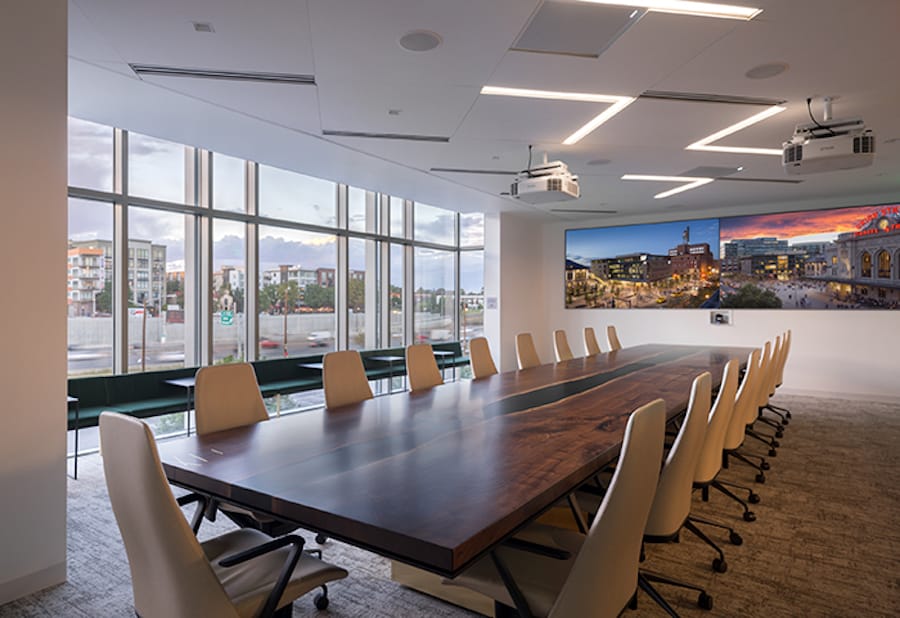
Now, there’s definitely the “we want a big video wall because it’s cool” factor, but even that’s usually purpose-driven. We’re seeing a lot of video walls that buildings are putting in to create space for advertising. So, it is also a revenue-generating opportunity, as well as just being able to splash some logos up there or some cool graphics.
The key is that these investments serve real business purposes. Companies need technology that helps them work better and faster than their competition.
Q: Which markets and applications are you seeing the strongest demand from?
We serve very traditional corporate audiovisual clients. We do hospitality, higher education, and K-12. Law firms and healthcare are very big for us. We’ve done quite a bit of live sound applications as well—some theaters and high school theaters, things like that.
And we’ve done some work in stadiums, too, like the project at Coors Field. It’s a really interesting redevelopment of a part of the stadium that has increased its capacity tenfold. I think it’s been a very beneficial area of the stadium for a lot of people, and it’s pretty popular.
We also have some long-running partnerships. Prologis, Charles Schwab, Brownstein—these are clients who trust us to handle their technology needs across multiple locations and projects over time.
Q: Post-installation, how does LINX ensure these systems continue performing for clients?
The expectation is that these things need to be up and running, and downtime costs businesses money. We need to be up and running. So we built a service team around being able to handle that.
We have direct contracts to do proactive preventative maintenance, take inventory of their systems, or even just monitor them remotely and fix a device when it drops offline. Either we can handle it remotely or decide with the customer if we need to actually have a service team member out there on site to help take a look at something that we couldn’t fix with a remote reboot or software/firmware update.
How many times do you reboot your phone or your laptop, and does that take care of a problem? Sometimes, yes, but there are still things that require people on deck, people ready to help service these systems. Even with all the talk about AI doing everything, customers still require services because things break. The service component is very key. We design and install solutions that are pretty stable and problem-free, but the ongoing support makes the difference in meeting client expectations.
Q: Can you explain LINX’s production room process and why it matters?
The concept is that we build the systems in our space, put them together, test them, and program them as if they were going into a client space directly. That way, we can program and test them before they go out to a client. We’re not doing all that work at the client’s site at the last minute when timing is absolutely critical.
This allows us to either find a product that doesn’t work as intended—sometimes that happens—or a product that fails out of the box. Sometimes, there are some tricky firmware issues to navigate. We can catch all that stuff before it actually hits the client’s site. Then, we can be more of what I call a “smokejumper” team. We can go in and align ourselves better with the construction schedule.
At first, it was an interesting conversation we had with general contractors because they just want to see forward progress. We had to tell them, “Hey, don’t worry, we ‘ll be ready. We have everything off-site. It’s tested. We’re actually going to spend less time on your job site.” There’s less ability for us to maybe ding a wall or create damage to the space because we’re dealing with a lot less product and boxes.
Once they understood that, they got it. Clients get it as well—they’ll often come visit and look at progress, but they’ll also see how the systems work and the actual control interface. It helps us catch design problems up front before we train the clients on-site on how to use the system.
Does LINX service clients outside the core Colorado area, and how?
We have the ability to go international with some partners if we need to, but where we can really stand out is that attention to detail that doesn’t matter where the customer is throughout the country. We’ve got a very sophisticated, detailed process that gives clients peace of mind that when they go to an office in New York City, the solution is going to look and behave exactly the same. And the service will be the same too.
How is AI affecting the multimedia AV industry now, and what do you think of its future impact?
People are attaching AI to just about everything. I’m surprised I haven’t seen it on Flintstone Vitamins yet! So, it’s creating a lot of industry confusion. Many of our manufacturer partners are talking about including AI within their software, and we’re still trying to understand what that means.
From an internal process standpoint, we are using AI technology to write some scopes of work. We’re also experimenting with a rough scope of work that translates into a rudimentary line schematic that our design team does. That just allows a much better handoff between my design engineering and project engineering teams.
One area often overlooked with collaboration solutions is audio quality, because that’s what you hear. Audio is a big part of what we do. Many of our manufacturer partners are saying they’re building AI into some of the audio processing, and I think it’s a great use of the tech for improving video conferencing and other communication and collaboration solutions.
Ultimately, I think AI will be a benefit to the industry. There are some really great applications to streamline things that take a lot of time, and that will make us more efficient and enable us to service our customers better. You know, when FedEx came in, they changed the game on overnight delivery service. Now we can be a little lazy in our daily business, knowing that we can still get a package somewhere overnight. So I think AI will ultimately help us be a lot faster and nimbler in how we deliver solutions in the AV space.
Want to connect with us? Let’s start the conversation here. We look forward to hearing from you!